To What End? Rethinking How We Measure Impact in Northern Virginia
This article was written by Aisha Ali, Sr. Director of Development & Communications, as the second piece in Britepaths’ Mobility Brief series.
In human services, we are very good at counting.
How many families received food. How many grocery gift cards were distributed. How many people attended a financial workshop. How many coaching sessions were completed.
These numbers matter. They tell us how many people we reached. But when quantity is the primary measure of success, we are checking the box without answering a more important question: Did that assistance actually change anything for the person who received it?
But at Britepaths, we are asking another question:
To what end?
If a family receives food assistance today, what is different six months from now? If someone completes financial coaching, did they gain the knowledge and confidence to make different decisions? If someone receives career coaching, did it help them move toward greater stability and opportunity?
Most importantly: Are the people we serve better positioned to participate fully in the economy, and in the prosperity Northern Virginia has to offer?
Those questions are harder to answer. They are also the questions I find myself coming back to again and again.
Outputs tell part of the story
Northern Virginia is one of the most prosperous regions in the country. Yet for many of our neighbors, working hard and doing everything expected of them does not always translate into financial security.
At Britepaths, we see this reality up close.
Every day, we meet people who are working but cannot absorb an unexpected expense. We see families balancing groceries against rent, workers whose jobs are threatened when transportation falls through, and people who earn more only to find that rising housing, childcare, groceries, and other expenses consume the increase.
These challenges do not exist in isolation.
Yet human services have traditionally been structured to address and measure individual needs.
A family needs food. Food is provided. We count the assistance.
Someone needs financial guidance. Coaching is provided. We count the session.
Those outputs are important. If someone cannot afford groceries this week, the answer cannot simply be a conversation about their long-term financial future. Stability today matters.
But if our measurement ends there, we miss the most important part of the story:
What happens next?
For more than 40 years, Britepaths has worked alongside Northern Virginia families. That proximity has taught us that a moment of assistance can be enormously important, but not sufficient on its own.
A grocery gift card can create breathing room. Financial coaching can build knowledge. Career support can open a door.
But did that breathing room create space for something more? Did knowledge translate into action? Did an opportunity ultimately increase stability?
The difference is between measuring an intervention and understanding a trajectory.
Economic mobility isn’t a single moment, and it is rarely the result of one program.
People experience their lives as a whole. Their ability to move forward can depend on whether they have stability today, knowledge and confidence to make decisions, access to meaningful opportunities, trusted relationships, systems they can navigate, and the ability to plan beyond the next emergency.
This is why Britepaths is recalibrating how we tell our own story.
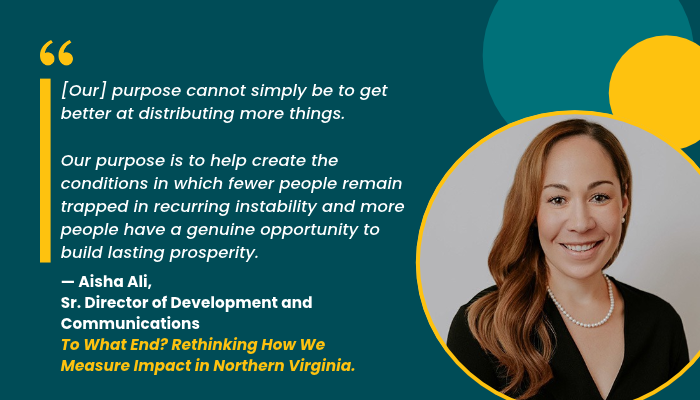
I keep coming back to this: our purpose cannot simply be to get better at distributing more things.
Our purpose is to help create the conditions in which fewer people remain trapped in recurring instability and more people have a genuine opportunity to build lasting prosperity.
Fund the destination, not just the activity
This shift has implications beyond Britepaths.
Outputs are appealing because they are concrete and easy to report. Funders can readily see how many workshops, grocery cards, coaching sessions, or households an investment supported.
Longitudinal outcomes are harder.
Progress takes time. It is rarely linear. Someone may build savings and then face a medical emergency. A worker may increase their income and then encounter a rent increase.
That does not mean the earlier intervention failed.
It means people’s lives are more complicated than a grant cycle.
If we are serious about economic mobility in Northern Virginia, then we have to care just as much about what happens six months from now as we do about what happened today.
That means investing in longer-term relationships, stronger outcome measurement, coordination across services, and the infrastructure needed to understand change over time.
Britepaths’ evolved mission calls us to fuel economic mobility and community vitality by investing in people.
That requires us to keep asking the harder question:
To what end?
Because the goal cannot simply be to get better at helping people survive recurring crises.
The goal must be to help build a Northern Virginia where more people have the stability, knowledge, connections, opportunities, and agency to participate fully in our region’s prosperity and where the systems around them make that progress possible.